
App Store ratings are the ranking signal most indie developers feel they can never catch up on. We wanted a real answer, so we counted the App Store ratings of every app sitting in the top 10 for 28 US keywords.
The short version: the gap is real at the very top, but the bottom of most top 10 lists is far closer than people assume. Half of the keywords we checked had at least one top 10 app with fewer than 100 ratings.
How we collected the App Store ratings data
I took 28 keywords from ASOClimb's US keyword pages, from small niches like color picker and pill identifier to crowded ones like ai assistant and calorie tracker. Each page lists the apps observed in App Store search for that term. These were observed on 17 November 2026.
For every app in each top 10, I pulled the rating count and average star rating from Apple's public iTunes Search API on 20 November 2026, matching each app by name and developer.
That gave us:
- 280 top 10 slots, of which 278 matched cleanly (two apps could not be matched and were left out)
- 264 different apps, since some apps rank for more than one term
- 273 slots with at least one rating, and 5 slots held by apps with none
The rating count here is the total for the US storefront. Apple says the summary rating is specific to each territory, so these numbers only describe the US store (Apple Developer: Ratings, reviews, and responses).
What Apple says about ratings and search
Apple's search page says results are based on text relevance (title, subtitle, keywords and primary category) and on user behavior, "downloads, ratings and reviews, and more". It also says ratings and reviews "can influence how your app ranks in App Store search" (Apple Developer: App Store search).
Apple publishes no weight and no threshold. So the useful question is how much ratings separate the apps that actually rank.
How many App Store ratings do top 10 apps have?
Across all 278 slots, the median app had 20,433 ratings. The spread is wide:
- 56 slots (20%) were held by apps with fewer than 1,000 ratings
- 31 slots (11%) by apps with fewer than 100
- 5 slots by apps with zero ratings
Sorted by position, the median does fall as you go down the list. The median app at rank 1 had 79,309 ratings. At rank 10 it was 3,901.
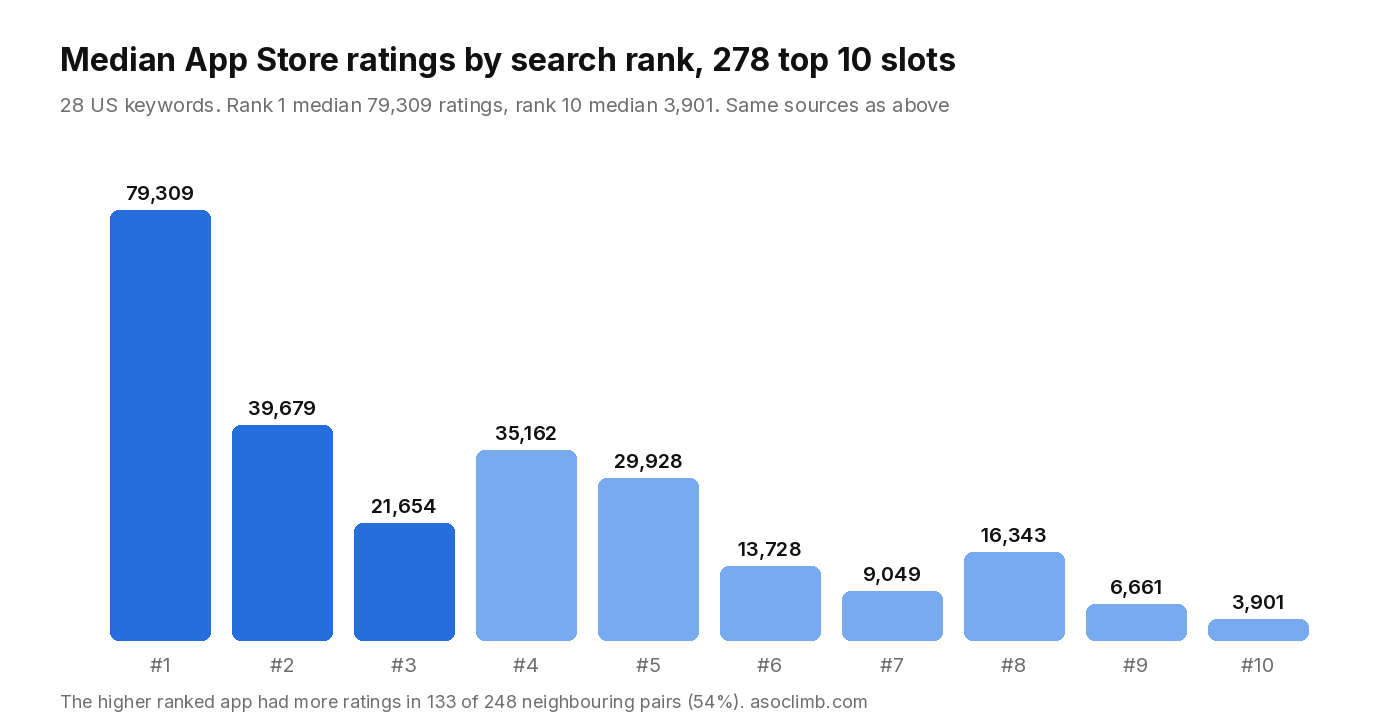
But look at the shape. Rank 4 had a higher median than rank 3, and rank 8 beat rank 7. When I compared every pair of neighbours (rank 1 against 2, 2 against 3, and so on), the higher ranked app had more ratings in 133 of 248 pairs. That is 54%, barely better than a coin toss.
The app with the most ratings is usually not number one
This was the number that surprised me most. In only 9 of the 28 keywords did the number one app also have the most ratings in its top 10.
Some examples from the data:
- lyrics: Genius is number one with 78,324 ratings. Shazam sits at number seven with 8,894,361.
- gps navigation: the number one app, a small one called GPS Navigation by Akhil Dholariya, had 336 ratings. Google Maps was at number five with 7,462,692.
- ai assistant: ChatGPT had 12,405,568 ratings and ranked third.
- ai headshot: the top app, PhotoToHeadshot, had 48 ratings and a 3.67 average. Facetune, with 382,062, was seventh.
Rating count does matter over the full list: the number one app had more ratings than the number ten app in 24 of 28 keywords. But inside the top 10, text relevance does a lot of the sorting. An app whose name matches the search exactly can sit above Google Maps. That fits what we found in our App Store title length study and why the keyword field is worth every character.
The number to beat is the weakest app, not the leader
When you size up a keyword, the leader's rating count is the wrong benchmark. You are not trying to replace number one on day one. You are trying to get into the list. So the useful number is the fewest ratings of any app already in the top 10.
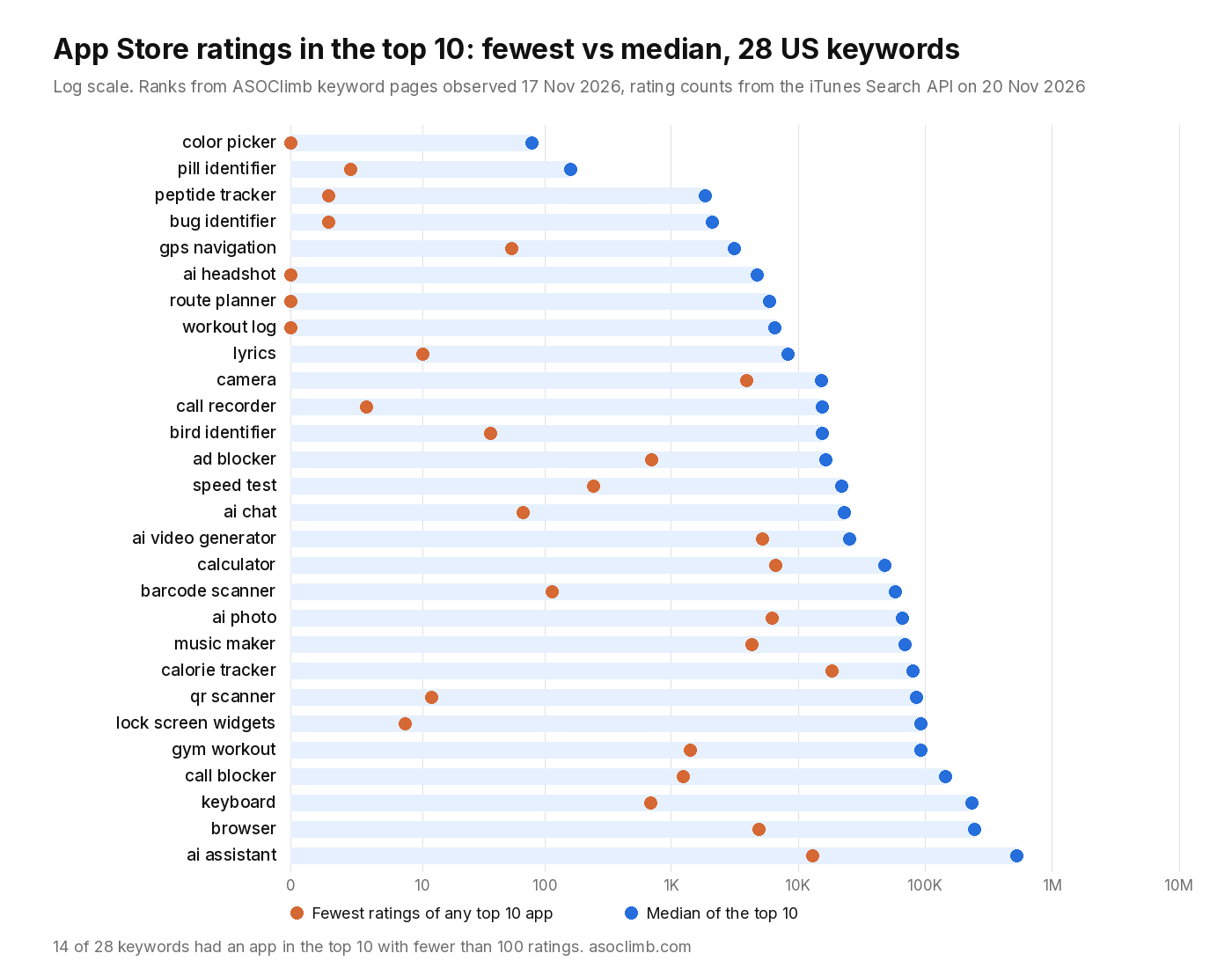
Here is what that looked like:
- 14 of 28 keywords had a top 10 app with fewer than 100 ratings
- 18 of 28 had one with fewer than 1,000
- Only 2 keywords had no top 10 app under 10,000: ai assistant (fewest 13,063) and calorie tracker (fewest 18,538)
The spread between keywords is also huge. The median top 10 app for color picker had 79.5 ratings. For ai assistant it had 528,160. Those are not the same game, and a new app should not plan for them the same way.
Two cases from small niches:
- color picker: the number one app, Color Picker by Hue Hoang Thi, had 983 ratings. Five of the top 10 had 5 ratings or fewer. You can see the current list on the color picker keyword page.
- workout log: Gript, first released on 18 June 2026, was number two with 68 ratings. Strong and Hevy, both over 100,000 ratings, were first and third.
This does not prove why the small apps rank. It only shows a low rating count did not keep them out. It is also why our keyword difficulty score looks at the apps currently ranking instead of only at search popularity.
Do star ratings matter as much as the count?
Inside the top 10, star averages barely moved with rank. The median star rating was 4.66 for ranks 1 to 3, and 4.66 for ranks 4 to 10 as well.
Most ranking apps are rated well. Of the 273 rated slots:
- 202 (74%) had 4.5 stars or higher
- 116 (42%) had 4.7 or higher
- 17 (6%) were under 4.0
Apple's own Calculator app was number one for calculator with a 3.06 average from 10,024 ratings, and Apple's Camera was number one for camera at 3.4. A name that matches the search, plus a built in audience, can outweigh weak stars.
So I would not chase a star number for ranking. Stars matter for conversion. Your rating shows next to your icon in search results, and a 3 star app next to a list of 4.7 star apps is a hard sell. Better conversion means more downloads, and downloads are a signal Apple does name.
How to get more App Store ratings without breaking the rules
Both stores give you an official prompt, and both limit how often it appears.
iOS: use the system prompt, at a good moment
Apple says the SKStoreReviewController prompt can be shown up to three times in a 365 day period. App Review Guideline 5.6.1 says to use the provided API and that Apple "will disallow custom review prompts" (App Review Guidelines).
A few practical rules:
- Ask right after a win: a finished workout, an exported file, a bird correctly identified.
- Never ask on first launch or in the middle of a task.
- Do not put a "Do you like the app?" screen in front of the prompt. Google's review guide bans that exact question, and I follow the same rule on iOS.
- Make support easy to find, so unhappy users email you instead of leaving one star.
Android: the in app review API has a hidden quota
Google Play limits how often a user sees the review dialog with a time based quota, and Google does not publish the exact number. Google also says not to put the review flow behind a button, because the user may have hit the quota and nothing will appear (Android Developers: In app reviews). For the rest of your Play listing, see our Google Play store listing guide.
Reply to reviews and close the loop
Apple lets you respond to any review in App Store Connect, and the reviewer is notified and can update their review. When an update fixes a common complaint, say so in your App Store release notes and reply to the reviews that raised it.
Think twice before resetting your rating
Apple lets you reset the summary rating when you release a new version, but recommends using this sparingly because "having few ratings may discourage potential users from downloading your app". Written reviews stay on the page either way.
A quick check for your own keywords
This is the routine I run before I commit a keyword to a subtitle:
- Pull up the ASOClimb keyword page for that exact term in your main storefront. Our rankings by country post explains why every storefront is its own list.
- Find the app in positions 1 to 10 with the smallest rating count. That number is your entry bar.
- Look at that app's name. If the search term is in it, the app is probably ranking on relevance, and you can do the same with your own metadata.
- Put your own rating count next to the entry bar. Close to it means the term is worth a try. If no app in the list sits below 50,000, start with a longer, more specific term and come back later.
Try it on your own keywords
Every ASOClimb keyword page, like the gps navigation keyword page, shows the apps currently ranking so you can run this check in a minute. To check if your own listing matches a term, try the free keyword checker, or run Wow Keywords on ASOClimb for popularity and difficulty scores. The Free plan needs no card, and plans are on the pricing page.
FAQ
Do App Store ratings affect search ranking? Apple says ratings and reviews can influence how your app ranks in App Store search, next to text relevance and downloads. It publishes no weight. In our data of 278 top 10 slots across 28 US keywords, the higher ranked app had more ratings in only 54% of neighbouring pairs, so ratings did not decide the order on their own.
How many ratings does an app need to rank in the top 10? There is no fixed number. In our check, 14 of 28 US keywords had a top 10 app with fewer than 100 ratings, while the weakest app in the ai assistant top 10 had 13,063. Look at the weakest app already ranking for your keyword.
What star rating do top ranking apps have? The median among 273 rated top 10 slots was 4.66 stars, and 74% had 4.5 or higher. Ranks 1 to 3 and ranks 4 to 10 had the same median, 4.66.
How often can I ask users for an App Store rating? With SKStoreReviewController, the system prompt can appear up to three times in a 365 day period. Apple's guidelines disallow custom review prompts.
Should I reset my App Store rating after a big update? Only if the old rating reflects problems you have fixed. Apple recommends using the reset sparingly, because few ratings can discourage downloads, and written reviews remain visible.